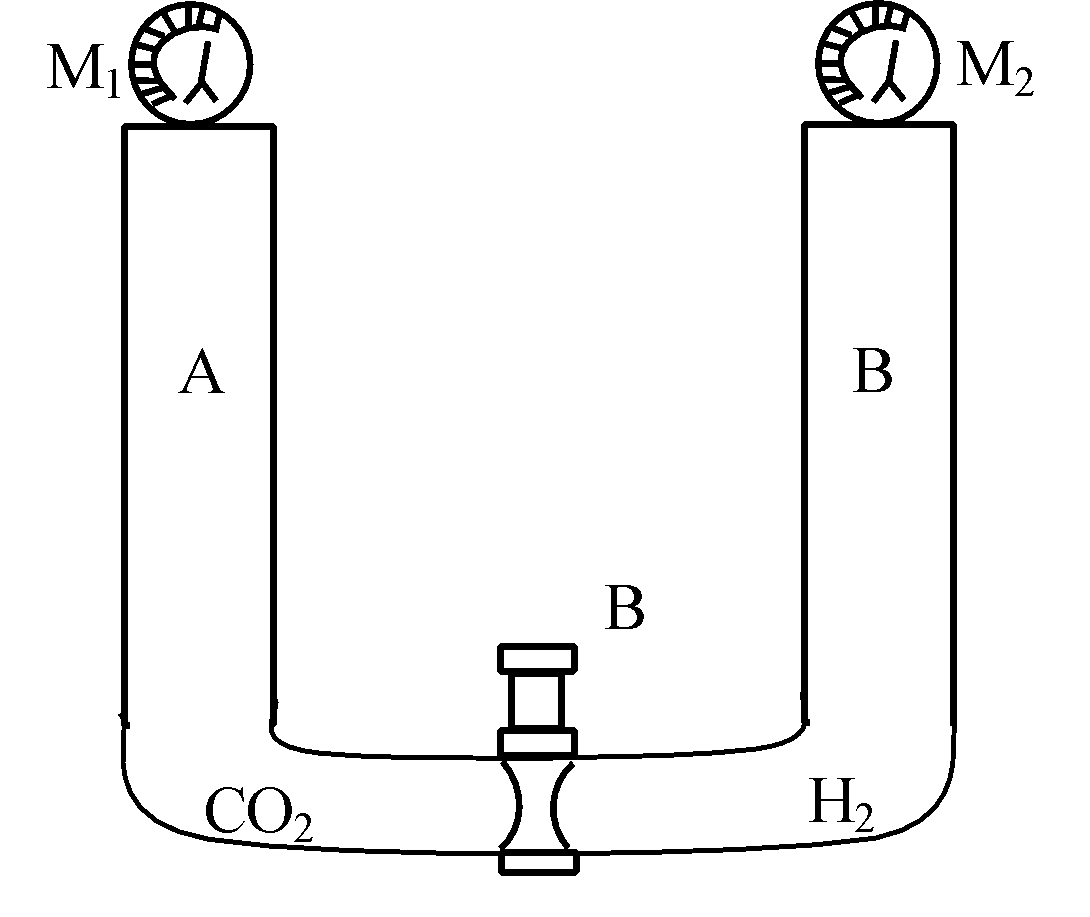
Vessels A and B contain carbon dioxide (CO 2 ) and hydrogen; (H 2 ). Pressure-gauges M 1 and M 2 register equal pressures. In which direction will gas flow if the valve K is opened (Fig.)? What will happen if the same experiment is carried out with the vessels turned so that the pressure-gauges are underneath?
Text Solution
Verified by ExpertsCHECK THE SOLUTION.
Sol. The pressure on the valve from either side will not equal the pressure registered on the gauges. To the latter pressure must be added the hydrostatic pressure of a column of gas ρ gh. Since the density of CO 2 is greater than that of H 2 , the pressure on the valve from the left will be greater than from the right, and after the valve is opened part of the carbon dioxide will pass into the vessel containing hydrogen.
In the second experiment the pressure-gauges will be under-neath. In this case the pressures at the valve will be ρ gh less than those registered by the gauges, If the pressure-gauges read the same, then the pressure of hydrogen on the valve is greater than that of the carbon dioxide, and when the valve is opened, part of the H 2 will pass into the vessel containing CO 2 .
Prepare Smarter with CGP Edu
Get practice questions, solutions, and test series in one place.
Write a Review
Share your experience with this question and solution.
Commentary
Send your comment, doubt, correction, or feedback to admin.
Similar Questions
Explore conceptually related problems